
A speed limiter lets you set a maximum speed that the car will not pass while you drive with the accelerator. You set the limit, you keep control of the pedal, and the car stops you drifting over the number by accident. It is not cruise control, and it does not know the legal limit for you. We teach learners in automatic electric cars around Alton, Basingstoke, Hook, Newbury and Thatcham, and this is the plain explanation we would give you before you meet one on a test or in a first car. 🚗
TL;DR
- A speed limiter caps your top speed. You still press the accelerator, and the car simply stops speeding up at the limit you chose.
- Cruise control does the opposite job: it holds a speed for you without the pedal, until you brake, accelerate or switch it off.
- Setting one is usually a few steering-wheel buttons: switch on, set the current speed, adjust, pause, cancel. The labels differ by make, so read your car's handbook.
- You can override it by pressing the accelerator firmly. The driver, never the system, is responsible for obeying the speed limit.
- Cars do not have to be fitted with one in the UK. Mandatory limiters apply to buses, coaches and heavy goods vehicles.
Table of Contents
- What a speed limiter actually does
- Speed limiter vs cruise control
- How to set, adjust, pause and cancel a speed limiter
- Overriding the limiter: what happens when you press hard
- Hills, warnings and other limits
- Is a speed limiter the same as intelligent speed assistance?
- Are speed limiters compulsory in the UK?
- When a speed limiter is worth using
- Learning with us
- Our view: control, not gadgets
- FAQ
- Sources
What a speed limiter actually does
Think of it as the reverse of cruise control. Volvo's UK support guide describes it in exactly those terms: you regulate speed with the accelerator but are prevented from accidentally exceeding a pre-selected speed.
Ford UK explains the same idea for its Adjustable Speed Limiter: the driver sets a maximum, the car will not accelerate above it, and slows if you lift off. The set limit shows in the instrument cluster, and the controls sit on the steering wheel.
A few details worth knowing:
- It limits power, it is not a brake pedal. On some cars, such as the Mercedes-Benz C-Class, the system can also apply the brakes automatically to bring you down to the stored limit. Others do not, so do not assume yours will.
- It can be temporary or long-term. Mercedes describes a variable limit for short spells, such as a built-up area, and a permanent limit for longer use.
- Your handbook has the numbers. Minimum and maximum settings vary. Renault's UK manual, for example, gives a minimum of 19 mph and a range up to 112 mph for its system, while Ford quotes 20 to 110 km/h for its own.
Speed limiter vs cruise control
The two are often side by side on the same stalk or steering-wheel cluster, which is why learners mix them up. The difference is who is working the pedal.
| Speed limiter | Cruise control | |
|---|---|---|
| What you set | A maximum speed | A speed to hold |
| Accelerator | You keep pressing it | You can take your foot off |
| What happens at the set speed | The car stops accelerating | The car maintains that speed |
| Override | Press the pedal all the way down | Brake, accelerate or switch it off |
| Best for | Busy roads with a limit you must not exceed | Steady, clear roads |
Carbuyer sets out the same split: with a limiter you still have to press the accelerator and the car stops at your chosen speed, while cruise control holds the speed without the pedal. It adds that a limiter suits busy speed-limit zones where you want to control your speed without going over.
A third term you may see is adaptive cruise control, which also keeps a gap to the vehicle ahead. Conventional cruise control does not normally adjust to keep that distance, as DriveSmart's explanation of speed assistance systems points out.
How to set, adjust, pause and cancel a speed limiter
Every manufacturer labels the buttons a little differently, so treat this as the pattern rather than a script. The Renault and Ford manuals show it clearly.
- Switch the system on. There is normally a dedicated limiter button on the steering wheel or a stalk. The limiter usually starts in standby, which means it is on but not yet restricting you.
- Set your speed. Either store your current speed with a SET button while you are driving at the speed you want, or scroll to a number. Volvo's guide notes some cars let you store a speed while stationary as well as while driving.
- Adjust it. A short press normally moves the limit in small steps and a long press in bigger steps, according to Renault's UK manual.
- Pause it. A standby or cancel button suspends the limit but keeps the number in memory. Ford's manual describes a resume button that recalls the stored speed.
- Switch it off. Press the on/off button until the display confirms it is off.
Where it goes wrong
- Setting it on the move at the wrong moment. Buttons are on the steering wheel so your hands stay on it. Set the limit when the road is quiet, not in the middle of a roundabout.
- Reading the dash in the wrong units. Some manuals quote km/h. Your UK car's display will normally be in mph, so check which you are looking at.
- Forgetting it is on. If you set a low limit for a village and then reach a faster road, the car will not accelerate as you expect. Look at the cluster, then change or cancel it.
New to automatic controls generally? Our guide to automatic car controls covers the pedals, selector and switches you will see around the wheel.
Overriding the limiter: what happens when you press hard
A limiter is designed so you are never trapped by it. Pressing the accelerator firmly all the way down temporarily overrides the limit, which can matter if you need extra power to complete an overtake safely.
Ford's manual says that pressing firmly temporarily turns the system off and that it reactivates once your speed falls below the set speed. While you are above it, the indicator flashes and a warning tone sounds.
Two habits keep this safe:
- Do not use override to go faster than the legal limit. It is there for emergencies and safe manoeuvres.
- Once you have finished, ease off so the limiter takes over again, and check the display.
Hills, warnings and other limits
A limiter is a helper, and it has edges. Ford's manual warns that going downhill your speed may rise above the set speed, because that system does not apply the brakes, and a warning appears. On a long descent, you manage speed yourself with the right braking technique. In an automatic, our guide to engine braking in an automatic shows how to hold speed on a hill, and the hill hold control guide deals with the opposite problem when you set off uphill.
Some other points that apply in everyday use:
- A limiter setting is not the legal limit. DriveSmart stresses you should not assume the figure is either the legal limit or a suitable speed for the conditions. Rain, fog and busy streets can all call for slower than the number on the dash.
- A limiter does not steer, brake for hazards or watch pedestrians. You do.
Is a speed limiter the same as intelligent speed assistance?
Not quite, and this is where much of the confusion on search results comes from.
A limiter you set yourself is manual: you choose the number. Intelligent Speed Assistance, or ISA, is a system that tries to work out the speed limit and helps you stay within it. Croner explains that ISA gets its information from road-sign recognition or map data. Missing, dirty or hidden signs, or poor weather, can give a wrong limit, which is why the driver must be able to switch it off and exceed what it shows.
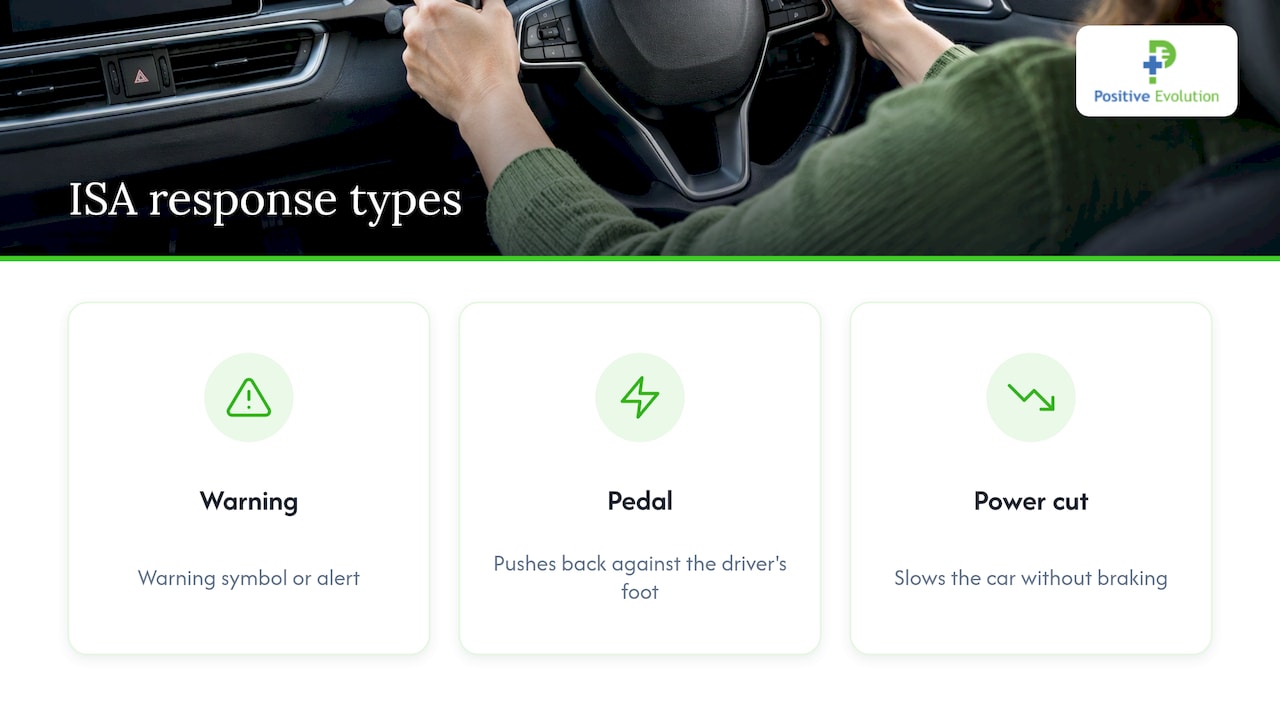
Carwow describes three kinds of ISA that car makers can fit: a warning symbol or alert, a pedal that pushes back, or a system that reduces engine power to slow the car to the limit without braking. Ford offers an Intelligent Speed Limiter that adjusts its maximum to the sign its camera reads, and notes it may be an optional extra on some models.
The key point is the same for every type. The UK government states that ISA supports the driver in following speed limits, that the driver can always override a speed control system by pressing the accelerator, and that it remains the driver's responsibility to comply with statutory limits.
If you want to learn what the limits are and how the signs work, start with our guide to road signs for learners and the one on 20 mph limits.
Are speed limiters compulsory in the UK?
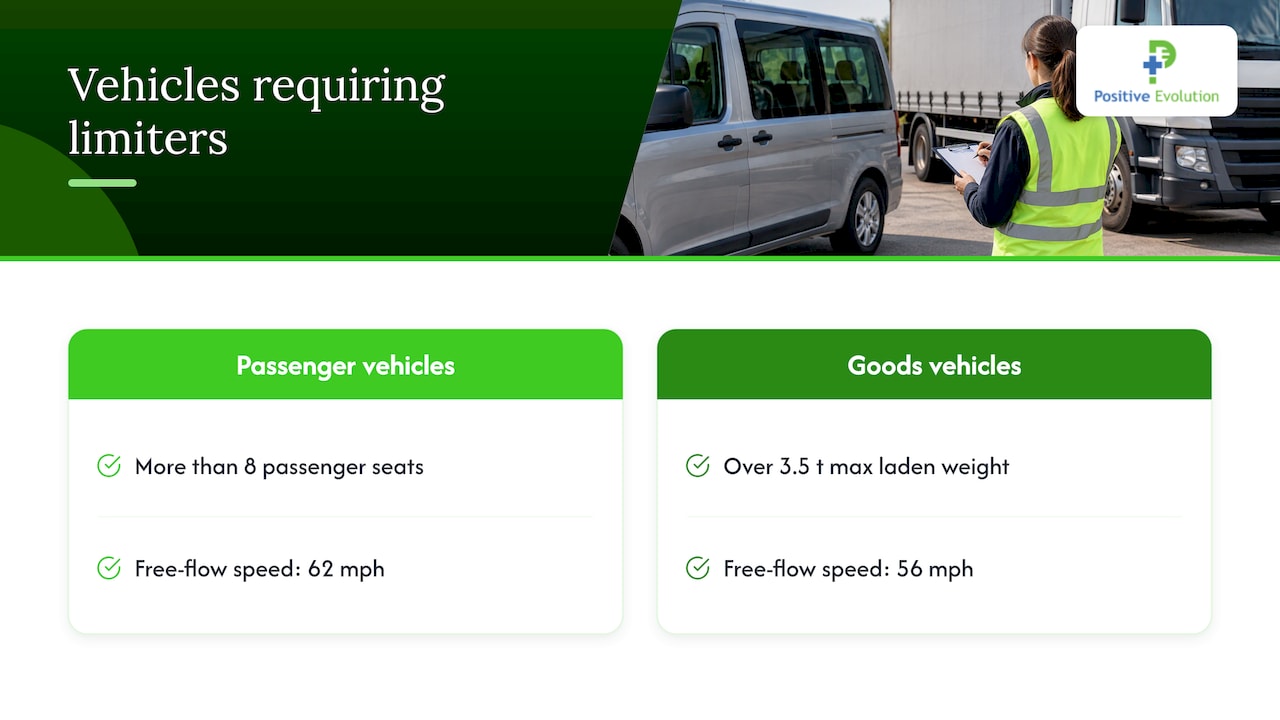
Not on a car. GOV.UK says a speed limiter must be fitted to vehicles with more than eight passenger seats, such as buses, minibuses and coaches, and to goods vehicles over 3.5 tonnes maximum laden weight. These limiters restrict the fuel supply to the engine, so such a vehicle may not be able to reach the speed limit on the road.
The Department for Transport's report on free-flow speeds gives the figures: 62 mph for passenger vehicles over eight seats and 56 mph for heavy goods vehicles. It explains the reason: accidents involving heavier vehicles tend to be more severe, because they are less manoeuvrable.
So on a car, whether you have a limiter depends on the make, model and specification. Many newer cars have one as a driver aid alongside cruise control, which is where you will meet it.
When a speed limiter is worth using
Think of a limiter as a tool for the moments when your attention is divided and the limit matters most.
- Roadworks and temporary limits. A driver on a forum thread about the feature mentions using it in roadworks, such as on the M4 near Newport, to avoid creeping over. Our guide to smart motorway rules covers variable limits and the red X signal.
- Village and town edges. Set it as you approach a lower limit so a downhill run does not push you over.
- Narrow rural roads. You keep full control of the pedal while holding a ceiling. Our country road driving guide has the rest of the routine.
- Busy traffic when you feel pressured. A set ceiling can help you stay calm, and our piece on road rage as a learner is a useful companion.
One caution for learners: your priority is observation, mirrors, junctions and hazards. Learn to judge speed by eye and by the speedometer first, then treat the limiter as a back-up, not a replacement for your own judgement. Keep your hands on the wheel when pressing buttons, and never fiddle with settings in a tricky spot.
Learning with us
The quickest way to feel comfortable with modern driver aids is to learn in a modern car. Every lesson with Positive Evolution is in an automatic, zero-emission electric car, taught by a DVSA Approved Driving Instructor who is Enhanced DBS checked. You can follow your progress, and parents can follow along, in the Total Drive app. 🌱
Prices on our payment page are:
- 2 Hour Lesson: £99
- 10 Hour Lessons Package: £475
- 20 Hour Lesson Package: £935
- Driving Test Lesson: £148
Gift vouchers are available for the 2 Hour Lesson (£99) and the 10 Hour Package (£475), which suits a parent buying for a teenager.

If you want to book, you can do it online or through the app on our lessons page.
Our view: control, not gadgets
We teach safe driving for life, and that starts with the driver, not the dashboard. A speed limiter is a good idea because it is simple: you choose a ceiling, you keep your foot in charge, and the car helps you avoid creeping over.
The danger is a learner who trusts the number on the display more than the road in front. A limiter cannot read a school gate, a wet bend or a cyclist. Your eyes, your mirrors and your judgement do that, and we build those habits first.
That is one reason we teach in automatic electric cars. With no clutch or gears to think about, you spend more of the lesson looking, planning and judging speed. Then, when you meet a limiter in your first car, it is one more useful tool you already know how to place.
Learn the habits, then let the technology back them up. 🌟
Stuart Chant
FAQ
Can I use a speed limiter and cruise control together?
They do different jobs, so most cars let you choose one at a time. The limiter sets a ceiling while you use the pedal, and cruise control holds a speed without it. Your handbook will say how your own car switches between them.
Does a speed limiter stop me going over the speed limit?
Only the number you set. It does not know the road's legal limit unless it is an intelligent system, and even those can misread signs. You are always responsible for staying within the limit, as the government's guidance on ISA states.
How do I override a speed limiter?
Press the accelerator firmly, all the way down. The limit is suspended temporarily, and on many cars it returns once your speed drops back below the set figure. Use this for safety, such as completing an overtake, never to go faster than the legal limit.
Do I need a speed limiter in my car?
No. Limiters are only compulsory on buses, coaches and heavy goods vehicles, according to GOV.UK. In a car it depends on the model and spec.
Sources
- How Does a Speed Limiter Work? (Ford UK)
- V40 Speed limiter, getting started (Volvo Support UK)
- Function of the limiter, C-Class Estate March 2025 (Mercedes-Benz UK)
- Speed limiter user manual (Renault UK)
- Driving Aids, Speed Limiter (Ford owner manual)
- Adaptive cruise control explained (Carbuyer)
- Speed Assistance Systems Explained (DriveSmart)
- Intelligent Speed Assistance (Croner)
- What is a speed limiter on a car? (Carwow)
- Mandating vehicle safety technologies in GB type approval (GOV.UK)
- Speed limits (GOV.UK)
- Free flow vehicle speeds Great Britain: 2015 (DfT)